Appearance
Color themes, gradients, shapes and brand characters
Answered 5 October 2026: all 4 recommendations accepted. These describe an identity system, not four new types of content. A guidelines document, an illustration and a video keep their own types.
The recommendations below are the accepted meanings. Examples and alternatives are retained as the review record; no further answer is needed on these choices.
| Proposed name | Recommendation |
|---|---|
| Themed Color Palette | Keep a palette assigned to a particular product, subject or other stated context distinct from the general palette. |
| Gradient System | Keep reusable gradient choices and their application rules distinct from simply seeing a gradient. |
| Shape System | Keep a reusable set of constructed shapes and rules for combining them. |
| Brand Character System | Keep recurring brand characters and their identity rules; do not require every character to be a mascot. |
What you already settled
You asked us to extract and review the identity vocabulary. That request did not approve every extracted term. The identity program, the pieces it gathers and the elements those pieces show remain distinguishable. Products can have their own identities while retaining their relationship to a company.
A source's documented claim stays separate from our interpretation. A piece can demonstrate a visual treatment without proving a rule for the whole brand. These choices apply that existing distinction; they do not ask you to approve it again.
For example, you could find an illustration because it uses a gradient, open the guideline that explains the gradient rules, then explore other supported examples. The illustration does not become the guideline, and the guideline does not prove that every gradient by that company follows the same system.
1. Color can belong to a particular context
Recommendation: use Themed Color Palette for colors deliberately assigned to a named context within an identity. The context might be a product, topic or campaign. This revises the older proposed name Topic Color Theme, which is too narrow for product-specific examples. It does not make those contexts interchangeable or create a new product or campaign from a color.
Checked example: GitHub's current color guidance distinguishes its general palette from Copilot and Security themes. The inspected examples show themed applications alongside the core palette. The useful research question is which colors the source assigns to that context, not simply whether an image contains purple or blue.
Counterexample: a blue product photograph does not establish a security theme. A one-off campaign using purple does not, by itself, establish that purple is a permanent product color. A palette used throughout the identity may belong to its general palette rather than a special theme.
Alternative: keep these within the general Color Palette description, with context explained in prose. That keeps the vocabulary smaller. I recommend the distinct element because someone should be able to find and compare context-specific palettes without reading every guideline in full.
What changes downstream: retain the palette, its supported context and the source behind that connection. Search could distinguish a product's stated palette from colors observed in its marketing. The same company or product can have several contextual palettes; do not force one color scheme onto all its work. Exact storage and filters still require implementation review.
2. Gradient rules are more than a gradient in an image
Recommendation: keep Gradient System as an identity element. It means a reusable set of gradient choices and rules for applying them, such as color combinations, direction and permitted uses. It does not require every brand to have such a system.
Checked example: page 37 of GitHub's 2025 guidelines presents background gradients with specified color combinations, directions and examples. That is evidence of a described system in that edition. It is not a claim that those rules are GitHub's current policy.
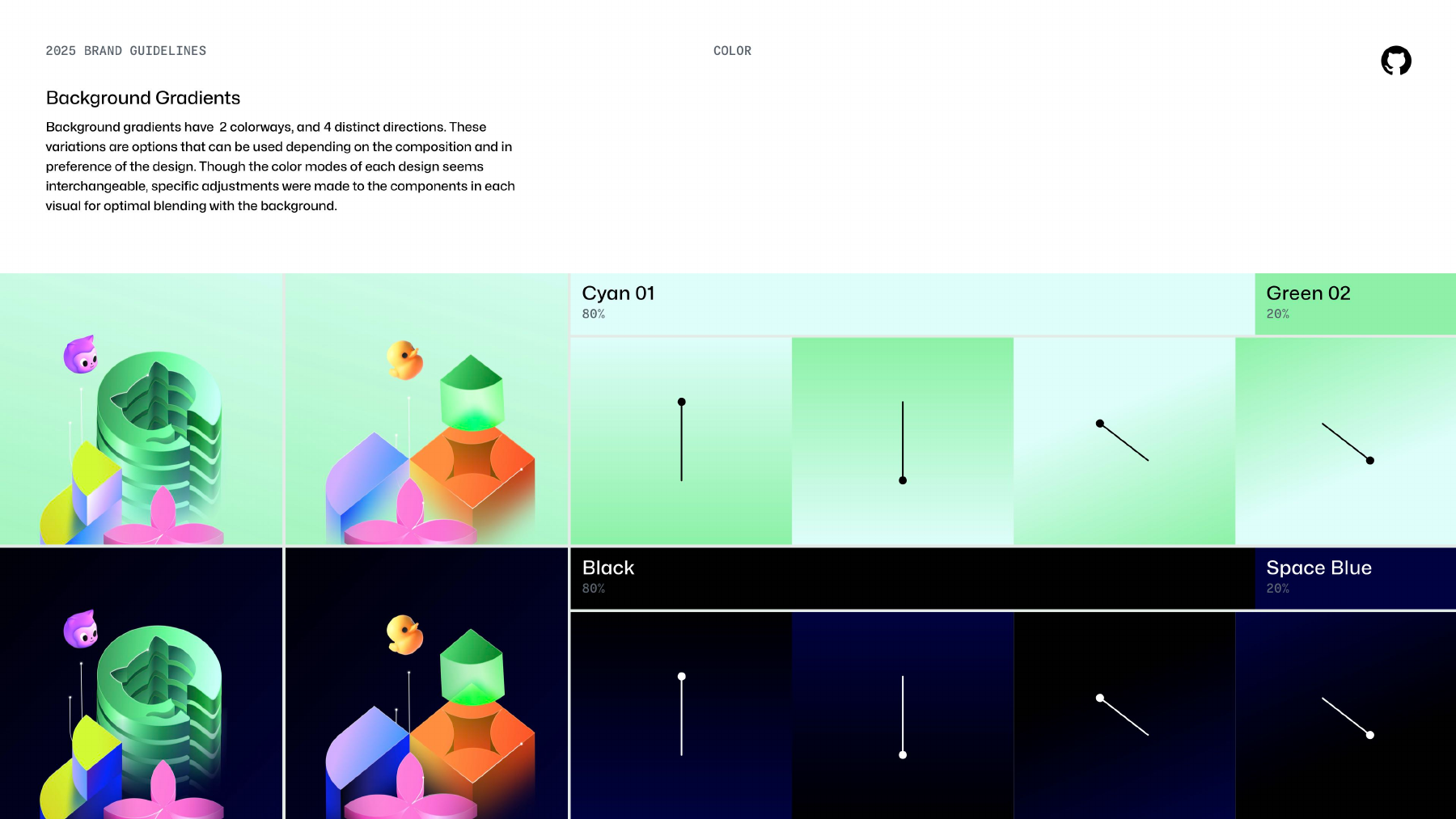
Counterexample: a smooth color blend in one launch image is an observed gradient. It does not prove a reusable brand system. The image can still appear in a gradient search without receiving the stronger identity claim.
Alternative: describe gradients within Color Palette or background treatment, without a separate identity element. That works for simpler identities. I recommend the separate element because a gradient system can govern direction, blending and application as well as its constituent colors.
What changes downstream: analysis must distinguish a document that defines rules from a piece that uses a visual treatment. Evidence links should let people move between the two. A later revision can change the rules without erasing the earlier edition or relabeling every old example.
3. Constructed shapes can form a reusable vocabulary
Recommendation: keep Shape System as an identity element. It describes a reusable set of shapes and their construction or combination rules. A set can support illustrations, patterns or other applications without becoming identical to any one of those finished pieces.
Checked example: pages 42–43 of the same 2025 guidelines show Git-Grid construction, a library of shapes and their use in dimensional artwork. The inspected grid shows related forms built from common geometry. The following page demonstrates how they become part of a finished composition.
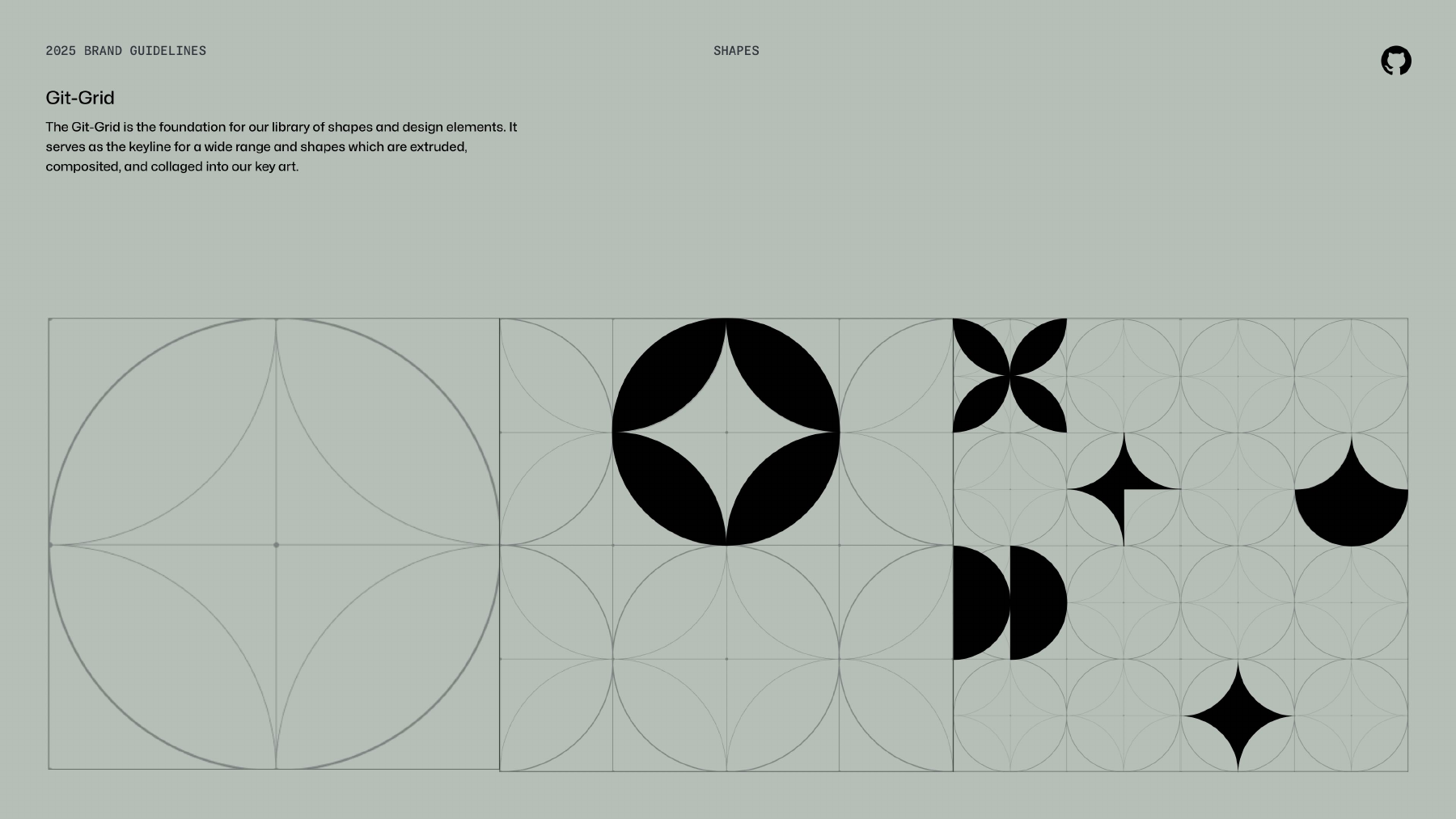
Counterexample: a circle used as a crop in one photograph is not proof of a shape system. A repeating wallpaper may demonstrate a pattern, but does not necessarily document the reusable shapes or rules behind it. A grid used to arrange text also answers a different question from how the shapes themselves are constructed.
Alternative: keep these examples under Illustration Style or Pattern and Texture, with construction described in prose. I recommend a distinct element because people can research the underlying shape vocabulary across several finished applications. A single piece may demonstrate more than one supported element; it needs no duplicate record.
What changes downstream: distinguish construction guidance, reusable shapes and their appearances in finished work. Do not infer that two brands share one identity system merely because both use circles. Preserve the owner, source and applicable edition when known; a similar appearance is an observation, not an ownership relationship.
4. A brand character is not always its logo
Recommendation: use Brand Character System for recurring characters and their identity rules. This resolves the older slash label Mascot / Character System. A mascot is one possible role of a brand character; recurring supporting characters can also belong. The system may cover a single character or a cast, their forms and where they are used.
Checked example: GitHub's current mascot guidance names Mona, Copilot and Ducky and gives usage guidance. The inspected Mona examples show several expressions and views. The source also distinguishes older styles and warns against using mascots as logos. Those are GitHub's rules, not a universal prohibition for every brand.
Counterexample: a person in an advertisement is not automatically a brand character. Neither is a one-off illustrated animal, a licensed character appearing in a partnership, or a product with a friendly name. Their roles and relationships need evidence. A character used as a logo can legitimately have both roles when supported.
Alternative: use the narrower name Mascot System and describe supporting characters elsewhere. That is familiar, but can make non-mascot characters harder to find. I recommend the broader name while preserving mascot as a searchable role or source description; its exact filter wording remains to review.
What changes downstream: distinguish the named character, the system describing it and the pieces depicting it. Preserve supported ownership, authorship and partnership relationships separately. A depiction does not create a company or product, and a change in rendering style does not automatically create a new character.
What this does to the existing library
The selected live data already includes descriptions of gradients and mascot characters, plus Color Palette and Mascots guideline sections. Those stored names do not prove the proposed relationships, source support or search behavior. No records have been relabeled. The evidence note explains the selected checks and the consumer problems left for the complete audit.
These named recommendations are approved. The remaining visual entries, unreviewed verbal and strategic entries, audio, environment and digital identity remain separate work. The Motion entrance, three strategy distinctions and three verbal-identity distinctions are already approved. Those answers do not approve every identity element. This page does not approve a database migration, new extraction prompt or automatic publication.
Return to the morning review desk for the other independent packets.
Prepared 5 October 2026.
This update records the reply and reconciles the affected guidance. The earlier source checks retain their preparation scope; this is not a fresh system audit.
Last reviewed 5 October 2026.