Appearance
Brand identity: names and a home for motion
Three choices answered on 5 October 2026. All three recommendations accepted. The recorded decisions now govern. The questions, evidence and alternatives below preserve what was reviewed; no answer is needed again.
Recorded answers
| Choice | Recommendation |
|---|---|
| Brand Book, Style Guide and Digital Guidelines | Find qualifying documents under Brand Guidelines, but classify by their contents rather than converting every matching title automatically. Keep the source title and scope. |
| Key Art and Key Visual | Use Key Visual for the shared kind when the work serves as a principal visual for a brand, campaign or product. Keep “Key Art” searchable and preserve the creator's wording. |
| Where motion belongs | Give Motion its own identity heading, with links to visual, audio and digital applications. Do not require every brand to have a complete motion system. |
Joe accepted all three rows separately. The remaining visual, verbal, audio, strategic, environmental and digital definitions stay in the larger identity review.
Already settled
The name Brand & Identity is approved. A piece and the identity elements it shows are different: a guidelines document may define a wordmark, color system and voice without becoming three documents. Useful parts can be browsed independently while retaining their parent document.
Source statements about a brand's strategy must remain distinguishable from our interpretation of its work. The current review does not reopen that rule or turn a single animation into proof of an official brand-wide motion policy.
1. Should guideline names resolve by meaning?
Recommendation: use Brand Guidelines when the document sets out how an identity should be expressed or applied. Brand Book, Style Guide and Digital Guidelines can lead people to that type, but a title alone should not decide the classification. Retain the original title and describe whether the document covers strategy, visual rules, writing, digital applications or a combination.
Checked example: OpenAI's Design Guidelines gives rules for the wordmark, logo, partnership lockups and typography. It qualifies by what it contains, even though its title is not “Brand Guidelines.” This is a review of that document's written guidance, not a claim that we have captured every asset on the site.
Counterexample from your source spreadsheet: its Brand Book row describes strategy, vision and values; its Style Guide row describes visual usage rules; Digital Guidelines describes web, mobile and social scope. These descriptions are related but not interchangeable. A strategy-only book should not acquire an identity-usage classification merely because its cover says “Brand Book.” A programming style guide would be another clear mismatch.
Alternative: retain Brand Book, Style Guide and Digital Guidelines as distinct types, each with a definition and overlap rules. This gives their names more prominence, but asks readers and classifiers to choose among titles that publishers use inconsistently. I recommend preserving those distinctions in the document's scope and source title instead.
Downstream: discovery can recognize familiar names without silently changing a document's meaning. Classification must inspect its purpose and contents. Search expansion and automatic label replacement are different operations; any implementation must preserve evidence, original wording and human corrections.
This revises the older proposal to convert all three names automatically. It does not approve a particular replacement type for every strategy-only book; unresolved cases remain available for review.
2. Is Key Art another name for a qualifying Key Visual?
Recommendation: share the Key Visual type when the meaning matches. Here, a key visual is a principal visual developed to represent a brand, campaign or product across its communications. “Key Art” remains a searchable name and the creator's original wording stays visible. The relationship to a particular brand or campaign still needs evidence.
Checked example: pages 16 and 17 of the supplied GitHub Brand Guidelines 2025 show two presentations explicitly titled “Key Art 01.” They use the same central illustrated composition with different backgrounds. They are an appropriate example for the shared name; those two pages alone do not establish every publication or campaign in which the artwork appeared.
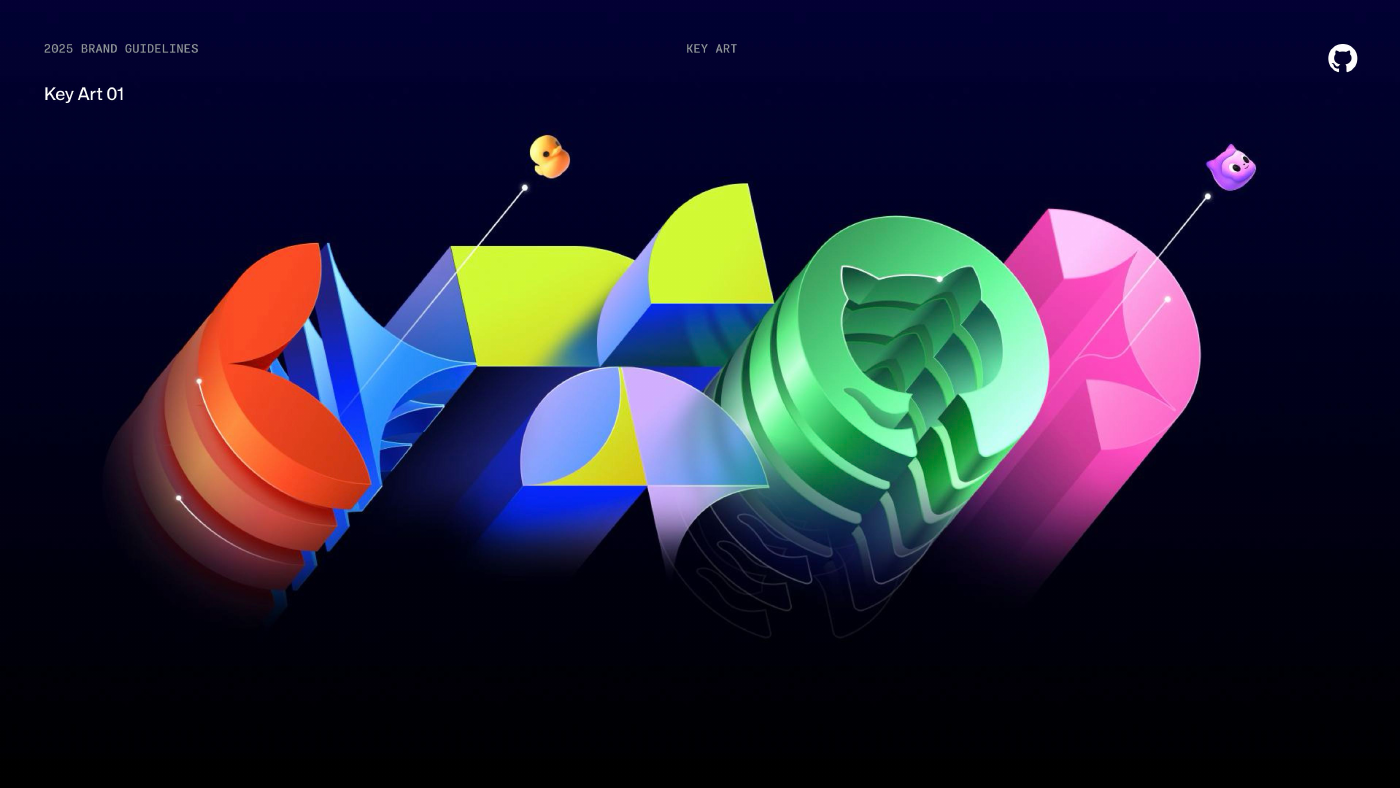
Counterexample: a keyframe used to plan an animation is not automatically Key Art or a Key Visual. Nor is every attractive illustration the principal visual for a body of work. File names and visual polish are insufficient evidence.
Alternative: keep Key Art as a separate type alongside Key Visual. Choose this if the distinction is useful to research and we can state a consistent boundary. Otherwise, the two lists would divide equivalent work according to the publisher's preferred term.
Downstream: both names should retrieve qualifying work. A key visual shown on a website, printed display or event installation stays connected to its appearances; this decision does not merge a photograph of the installation into the original artwork. Existing work, version and capture distinctions still apply.
3. Should Motion be an identity heading of its own?
Recommendation: keep Motion visible beside the other identity headings. It covers the stated movement principles, recurring behaviors and practical motion rules that help an identity remain recognizable. It can connect to logos, typography, interface interactions and sound without forcing all those subjects into a single exclusive branch.
Checked example: IBM's animation overview has its own Animation navigation section. Its written guidance distinguishes productive and expressive motion, and connects the approach to illustration and user interfaces. This supports a visible motion route across applications. It does not establish one universal industry hierarchy, and this review does not certify the animations on that page.
Your motion-discovery framework also separates principles, behaviors, techniques and implementation rules. It is useful evidence for the questions we need to represent. Its workshop structure should not become a mandatory set of populated fields for every brand.
Counterexample: finding a logo animation establishes that a piece uses motion. Without further evidence, it does not establish that the brand has published motion principles or that every other piece follows them. Equally, a brand without a documented motion system should still be collectable.
Alternative: place Motion only beneath Visual or Digital identity, as some earlier source structures do. That can make the top-level list shorter, but may hide movement that crosses product interfaces, campaigns, physical displays and audio. This choice concerns the identity headings; it does not change moment shelf groups or approve a database hierarchy.
Downstream: an identity page should connect documented rules to the relevant pieces and moments. The pipeline must distinguish a source's stated rule from an observed technique. Browsing can show both with their evidence and dates, without presenting our inference as the brand's own claim.
Scope and next step
Motion remains part of brand identity. It can connect to visual expression while having its own visible entrance. This is a browsing choice, not an exclusive parentage rule or approval of every motion element.
The evidence note records the inspected sources, selected live checks and local implementation concerns. Those checks are not a complete schema or deployed-pipeline audit.
These answers settle only the three choices above. They do not approve every visual or verbal element, the motion framework's exact layers, automated synonym conversions or any migration. The broader lists and remaining distinctions stay in the review plan.
Prepared 4 October 2026.
The review date below records a consistency check against the linked decisions and evidence. It does not change the dates or limits of the source inspections, or certify the complete database and pipeline.
Last reviewed 5 October 2026.