Appearance
Videos, promotion and partnerships — recorded answers
Answered on 5 October 2026: all four follow-up recommendations accepted. Brand Film, Product Film, Commercial and Promotional Ad leave the canonical whole-piece type list. Sponsored Content remains searchable through evidence and relationships. Offer leaves the whole-piece type list while actions, prices, benefits and terms remain searchable.
The recorded decisions preserve your reasoning. Campaign Film was already settled. The original sitting remains historical context. No new answer is needed for these choices; exact vocabulary, legacy mappings and implementation remain separate.
The proposals and alternatives below preserve what you reviewed. They do not establish that existing classifications, prompts or interfaces have changed.
Three choices to finish the video and ad meanings
You wanted to use your available time to answer the outstanding questions, then let the deeper audit follow. These choices use your campaign example and the evidence already gathered. The technical repair work remains recorded below; it does not have to be finished before you tell us what the product should mean.
| Choice | My recommendation |
|---|---|
| Brand Film and Product Film | Replace these broad types with the video's actual form and its campaign, subject and role |
| Commercial and Promotional Ad | Keep advertising evidence and original source wording separately from the piece's form |
| Sponsored Content | Make it a searchable, evidenced relationship or disclosure alongside the piece's form |
1. Brand Film and Product Film
Your example is a product-launch campaign containing a hero launch video, a key visual and a retail use of that visual. You should be able to open that campaign and see those things together. The video can show its media as Video, its lead role within the campaign, the product and feature it concerns, and a more specific whole-piece type when one fits. A demonstration and a user story can both belong to the same product campaign without becoming the same kind of video.
I recommend removing Brand Film and Product Film as canonical content types. Keep the original wording when a source uses it, and make searches for those phrases lead to relevant work using the supported relationships. Do not simply rename them Brand Video and Product Video as replacement types. A readable label such as “Hero launch video” can combine known facts without requiring another permanent type for every combination.
This does not require forcing every video into a narrower type. If its form or campaign is not yet known, it remains browsable as a video with that information unresolved. It also does not rename Documentary, Music Video or every other name containing Film; those boundaries get their own review.
The DevDay body of work described below illustrates why related media should stay together. Your hero-launch example illustrates the proposed display; it is not a claim that all those exact records or roles exist today.
Alternative: retain Brand Video and Product Video as broad content types alongside the more specific types. That gives familiar labels, but duplicates facts about subject and campaign and requires another rule for when to apply each.
Recorded answer: remove the two broad types under the preservation rule above.
2. Commercial and Promotional Ad
The collected ChatGPT Business image below says “Start your free trial.” It is an image, communicates an offer, and was collected from an advertisement source. Those facts are useful separately. A copy found later on the company's website should not erase its advertising history or prove that the website appearance was paid.
I recommend removing Commercial and Promotional Ad as canonical whole-piece types. Keep whether a piece was made for advertising when a source establishes that, where it actually appeared as an ad, and the words its maker used. Let people browse advertising work through those facts. Preserve the image or video's more specific form when known; do not invent one when it is unclear.
A studio calling its work a commercial is useful source information. It does not identify every paid placement. An advertisement-library record supports an advertising appearance; it does not establish all of the work's production history. Promotional wording alone establishes neither. The collection can hold partial evidence without pretending it knows the rest.
Alternative: retain one clearly defined Advertisement type for work created as advertising, while still recording each paid or organic appearance separately. That may feel more familiar, but requires evidence of the work's intended use and remains distinct from its distribution history.
Recorded answer: use advertising evidence and source descriptions without these two types.
3. Sponsored Content
In your creator-and-brand example, the work might be a tutorial, a user story or another kind of video. A disclosed sponsorship says something additional about who supported it and their relationship. A company supporting an event is another relationship; it does not make every photograph of the event sponsored content.
I recommend keeping Sponsored Content as a useful search and browsing label, based on evidence of sponsorship or a relevant source disclosure, rather than a separate content type. Preserve the original disclosure, who is involved, which work or publication it covers, and what remains unknown. Where the source only says “paid partnership,” keep that wording rather than inventing the terms of the deal.
The same work keeps its actual form. Paid amplification alone does not establish a creator sponsorship, and a general partnership must not be copied onto every associated piece as sponsorship. The IBM and creator examples you supplied illustrate the required distinctions; their specific commercial arrangements have not been verified here.
Alternative: keep Sponsored Content as an additional type as well as preserving the relationship and disclosure. That gives it a place in the type picker but duplicates a fact that can apply across many kinds of work.
Recorded answer: make Sponsored Content a searchable evidence-based label alongside type.
What your answers authorize
They settle the intended meanings and research paths. They do not delete existing labels or approve a migration. Before implementation, the full audit must account for every affected value, saved query, prompt, correction path and reader. Where a replacement cannot preserve useful information, that is a specific design gap to resolve before making the change.
The Offer choice was answered separately in the same reply. Its meaning and preservation requirements appear below.
Start with what someone wants to find
My recommendation is to describe a video through several clear questions. These are questions for the model, not a proposal for more required controls on every card.
| Question | Example of an answer |
|---|---|
| What can I open? | A video |
| What does it do throughout? | Demonstrates a product or tells a user's story |
| What is it about? | A named product and feature |
| What larger work is it part of? | A product-launch campaign, when evidenced |
| What part does it play there? | The campaign's lead video |
| Where did it appear? | An organic post and a paid placement |
The earlier decisions already separate campaign membership, the piece's role and its appearances. They do not require the person browsing to assemble a database query. A useful entrance can combine those facts and show a simple name.
“Brand videos” and “Product videos” could therefore be browsing entrances. Inside them, people could narrow to demonstrations, user stories, announcements and other useful kinds. This is a proposal to test, not an approved replacement of Brand Film or Product Film. Merely changing Film to Video would leave their overlap unresolved. A generic Video label alone would also lose useful distinctions.
Your follow-up puts the campaign at the center of the experience: a brand, product or feature campaign connects its lead launch video, website key visual and retail use of that visual. Video describes the media. The named product and feature remain connected subjects. This does not approve the browsing-shortcut proposal above; the admin prototype and its earlier research need to inform the next example.
“Hero” describes the lead role in a particular body of work; it should not automatically become another kind of video. Google's older video playbook uses hero as a programming role. That is supporting context, not a vocabulary we must adopt.
We can present a simple campaign page without forcing every piece into one mandatory hierarchy. A key visual can connect to its website appearance and its retail use. An adapted display and a photograph of that display may be distinct pieces with evidenced links. When collection has not yet established the campaign, the pieces remain available and the relationship remains unresolved. Your phrase “most likely” does not require inventing membership.
Walk the example before naming more types
You accepted the following explanation of your example. It is a model example, not an assertion that all these records have already been collected or linked. A launch introduces a product; an ongoing product campaign need not be a launch. Exact type names and campaign subtype vocabulary remain for reconciliation.
| Thing someone opens | How it connects |
|---|---|
| Product-launch campaign | Brings together related work and the product being promoted |
| Lead launch video | Belongs to the campaign; its lead role applies within that campaign |
| Key visual | Belongs to the campaign and can be used in several places |
| Website hero | Records the visual's use on a particular page; a materially different design may be a linked version |
| Retail display | Uses or adapts the visual in a physical setting |
| Photograph of the display | Documents that display; it is not the original visual itself |
The same full-frame animation found on a studio site can remain connected to a photograph showing it in an installation. Being collected from different sites does not break the relationship, but visual similarity alone is not enough to prove that they are the same work. An event, campaign and studio project can each provide useful context without being forced into one parent chain.
The admin prototype's existing model review makes similar distinctions between commissioned work, relationships, event occurrences and produced experiences. It also leaves campaign adoption unresolved. That is useful prior analysis to reconcile, not proof that the production model or the final campaign experience is finished.
What the DevDay example actually establishes
Checked on 4 October 2026. Studio Dumbar's DevDay case study describes an identity developed with OpenAI Design Studio. Its scope includes motion, sound, signage and interactive experiences. That supports your point: the useful thing to explore is the connected body of work, across media and physical settings.
Our database currently connects nineteen pieces to OpenAI DevDay 2025: thirteen videos, five images and the studio's written case study. All nineteen also share a source-page group. Every campaign membership currently uses the same general asset role. These are stored facts, not confirmation that every classification or connection is correct.
| What you can inspect | What that establishes | What still needs evidence |
|---|---|---|
| Image of bracket-shaped wayfinding | A photograph showing physical signage | Which original design or motion piece, if any, it should link to directly |
| Image showing character patches | A view of finished objects bearing the identity | Whether an original artwork for each object has also been collected |
| The video records and studio write-up | Other collected material in the same body of work | A verified match between a particular video and a photographed installation |
I inspected those two images and the studio's explanation. I have not established a specific video-to-installation match. Keeping everything together is useful; saying that one piece depicts another requires more evidence than sharing this page or campaign.
The current implementation also needs work. The portfolio importer preserves existing relationships when it recognizes an already-collected item. That does not prove it will create the complete relationship set for a new portfolio page. The inspected campaign-related-content interface chooses one membership, while the database permits a piece to belong to more than one campaign. Those are implementation findings to address; they are not questions for you to reapprove.
My recommendation remains to let someone open the campaign or studio project, browse its work, and distinguish an original asset from an image showing its use. Keep a direct “shows this work” connection only when supported. The example supports the relationships you approved; it does not prove that the collection and browsing paths implement them.
Commercial and ad need evidence and context
The original sitting was too definite about what should count as a Commercial. That definition is not approved. We should not infer paid placement from a video's polish, length, brand presence or promotional language.
There are two useful facts to preserve: what a source calls the work, and evidence of how it was distributed. A studio may call its work a commercial. An ad library may establish an advertising appearance. Those observations need their source and should not be treated as interchangeable.
The same post can have both organic and paid distribution. TikTok's Spark Ads documentation explicitly supports advertising with organic posts. My recommendation is to preserve both appearances and one underlying work. This supports separating distribution from identity. Your 5 October answer removes Commercial from the canonical type list while preserving these facts.
Commercial, Brand Film, Product Film and Promotional Ad are removed from the approved canonical type list by your answer above. Existing stored values remain unchanged pending implementation. Do not replace them all with an equally vague Marketing Video type. The implementation audit must test the accepted meanings against collected pieces and saved research paths before changing data.
Calls to action, price and what someone receives
Your requirement is broader than discounts. People need to find how work invites purchase, registration, membership or use of a new feature, including the specific part of a video where that happens.
I recommend preserving three separate observations:
- Requested action: what the audience is asked to do, with the actual wording and destination when known.
- Price: the amount, currency and billing basis actually shown, when present.
- Benefit and terms: what someone receives and any stated conditions, such as trial access, a bundle or a discount.
One closing card can carry all three. A signup instruction need not contain a price or a special offer. A price shown without an invitation is still a price. We should not force one choice to erase the others, and the wording should remain linked to its moment or other source location.
You accepted these separate observations and removing Offer as a whole-piece type. Offer remains a research concept. The exact fields and filter choices are not yet approved. Calls to action can stand alone, appear in an end card, accompany prices, or occur on a landing page or still image. An end card can contain only a logo. Preserve each observation at its actual location without calling a non-video part a moment.
What the current records preserve
A database check on 4 October 2026 found thirty-five moment classifications with the story job “call to action.” The current moment writer also preserves on-screen wording. Calls to action are therefore already represented in part; the remaining question is how to make the action, price and terms separately useful without losing their context.
These examples were first located through stored analyzer output. I then inspected frames from the collected media. That check supports the invitation and microwave-price examples below, but does not certify every transcript, moment boundary or thumbnail.
| Recorded example | What the review must distinguish |
|---|---|
| “Try Codex,” recorded within a user-story video | An invitation to use a product; the wording alone does not establish a free trial, price or destination |
| A stored description says an account dashboard is being generated | The checked frame instead shows a written usage-and-spending report. The stored description and wording need further verification; neither establishes the advertised product's price |
| Microwave prices shown while demonstrating shopping in ChatGPT | Prices for the displayed products; they must not automatically become ChatGPT subscription prices |
The older Pricing / CTA preview combines several meanings into one choice and also searches descriptions for price-related words. The inspected production moment writer does not store that preview's dedicated action-and-offer fields. The piece-detail interface reads a separate whole-piece value, which the current undeleted records do not contain. These paths need reconciliation; a working preview is not proof that the complete research path is implemented.
The recommendation therefore also needs to preserve what the wording refers to. Keep the named product, service or other subject when supported, and leave it unknown when it is unclear. Several observations may occur together and may appear before the ending. A call-to-action story label or a pricing end-card label alone cannot establish all the wording, conditions, subjects and source locations someone needs to compare.
The Offer decision on real work
You previously leaned toward removing Offer, then clarified that calls to action and offers must remain easy to study. On 5 October you accepted removing the whole-piece type while retaining the meaning. A call to action is an invitation to do something. An offer states what someone can receive and on what stated terms. They can occur together, but neither guarantees the other.
An invitation without an established offer
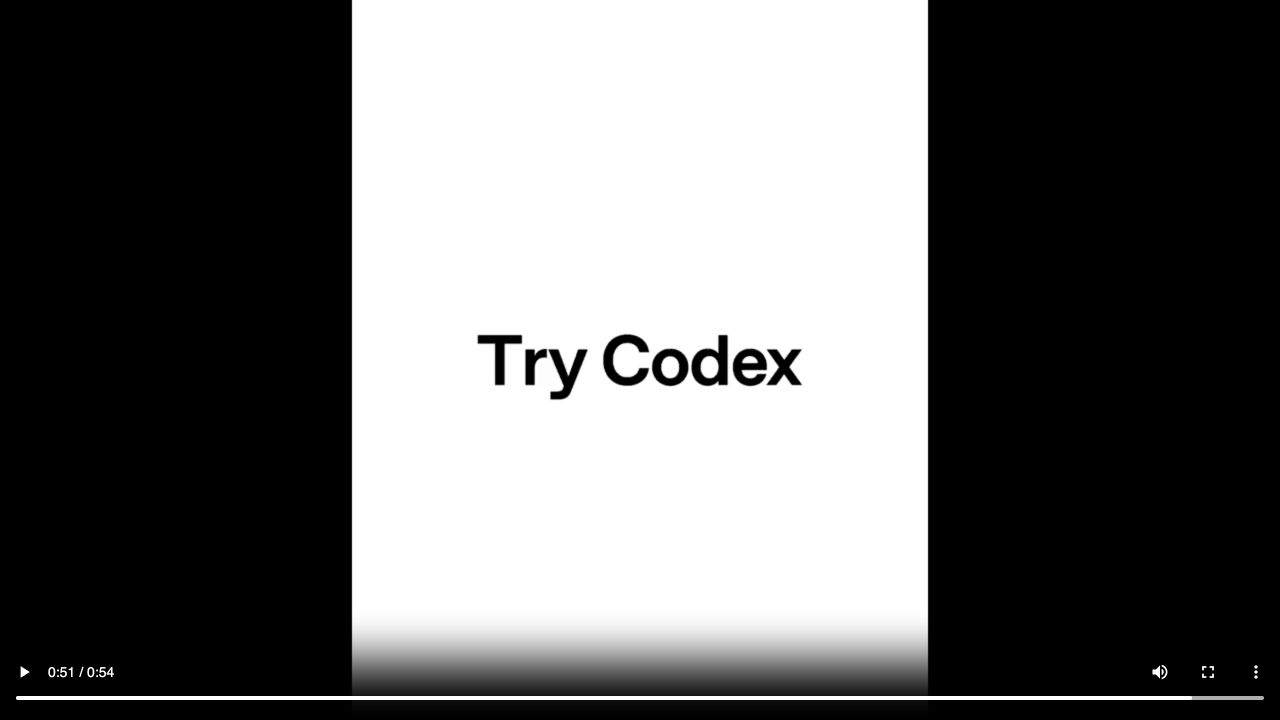
Source: the collected LinkedIn advertisement. Open the collected video near its closing invitation.
The video visibly says “Try Codex.” That supports an invitation to use Codex. Those words alone do not promise a free trial, establish a price or identify a signup destination. Someone researching calls to action should find this part of the video without the entire parent video becoming an Offer.
The stored thumbnail shows the speaker rather than these words. The captured frame also falls just outside the recorded moment's end. Selecting a useful thumbnail and validating the full interval are implementation checks still owed; this inspection verifies the wording, not the boundary.
An actual free-trial message

Source: the collected LinkedIn advertisement.
The image names ChatGPT Business and says “Start your free trial” and “Terms apply.” It has both an invitation and a stated benefit. The image does not establish the trial's duration, eligibility or later price. Its stored title mentions a month, but that is a different source of wording and was not verified from the image.
Under the recommendation, this image stays independently browsable. A person could find its free-trial message, inspect the original wording and see which terms are unknown. “Free” must not become an assumption that the product is permanently free, or that this historical offer is available now.
A price for something inside the demonstration
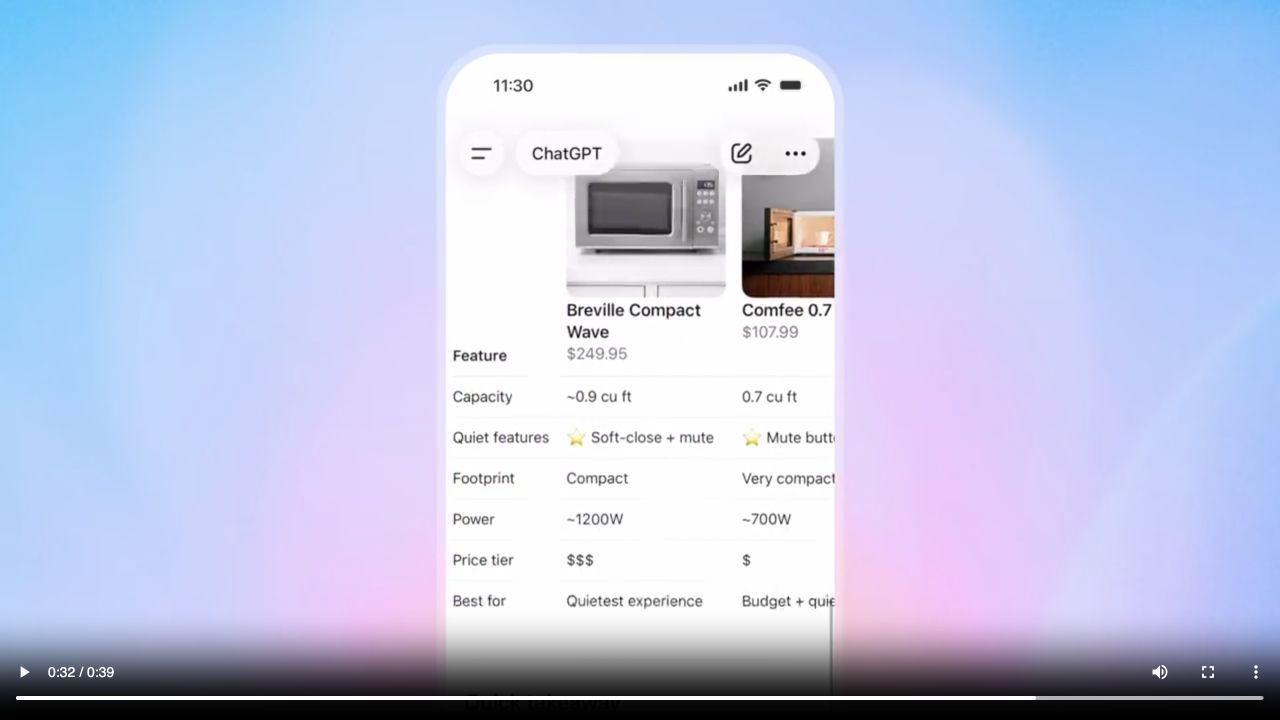
Source: Design your dream room by shopping with ChatGPT. Open the collected comparison.
This frame shows named microwaves and their prices inside ChatGPT. Those are displayed prices for the compared products. They are not a ChatGPT subscription price, proof of a discount, or independently verified current shop prices. Research should retain both the visible amounts and what they describe. Your separate question is how the product demonstrates shopping or comparison. That needs a supported product-feature link and a description of the activity, so a team can compare similar demonstrations across products. Neither the price nor a general product link identifies the exact named feature on its own.
What the choice changes
| Example | Earlier stored description, not an approved type | Required research result |
|---|---|---|
| Try Codex | A call-to-action moment inside a video | Find the invitation and open its verified location; an offer stays unknown |
| ChatGPT Business image | Collected image with historical advertising wording | Find the free-trial message and its wording; retain the image and unknown conditions |
| Shopping comparison | A video with a product-comparison moment | Find the demonstrated shopping capability and, separately, the displayed microwave prices at their source location |
My recommendation is to remove Offer as a whole-piece type, with preservation as a requirement. People must still be able to search for offers, invitations, prices and terms across complete pieces and the relevant parts of videos or documents. Several can occur in the same place. A match must say whether it describes the whole piece or only a part.
This does not replace offers with marketing intent. Intent says why someone made the work; it cannot preserve the actual invitation, benefit, amount, conditions or subject. It also does not turn every “try” or “join” instruction into an offer. Membership and feature signup remain useful actions even when no benefit or price is stated.
The alternative is to keep Offer as an additional type when communicating an offer is the main purpose of the whole piece. That could be familiar to browse, but it still needs all the separate observations and the distinction between whole-piece and partial matches. I favor the simpler type list because those observations support the research directly.
Company and product identities, campaign membership, versions, publications and captures keep their existing meanings. This choice does not invent missing relationships, make campaign membership required or change the definition of a moment. The advertisement names were resolved by the separate choices above; Corporate Film and the other historical alias pairs still need their own reconciliation.
Your approval settles the meaning. Before implementation, the database, prompts, correction rules and searches must prove that the information survives. A useful offer record must retain where and when its wording was observed, distinguish unknown from absent terms, and allow corrections without losing earlier evidence. The exact storage, filter names and presentation remain to design and verify.
Recorded answer: remove Offer as a whole-piece type while preserving searchable actions, prices, benefits, terms, subjects and source locations. Your request to compare Offer with CTA, claims, value propositions and taglines remains a definition audit; these are not automatically synonyms.
Partnerships and sponsored content
Your examples raise several related relationships: a brand working with an event, a creator working with a brand, and a particular piece funded or presented through that relationship. Record only the relationship the evidence establishes. An event partnership must not make every piece about that event sponsored content.
Your IBM/World Cup and Ninja/McDonalds examples remain illustrative cases you supplied; their specific arrangements have not been verified here. A separately verified example is IBM's partnership with Wimbledon, which includes technology and digital experiences. That demonstrates why a partnership may connect organizations, products, an event and several pieces of work.
YouTube's disclosure guidance covers branded content, sponsorships, endorsements and other commercial relationships through a paid-promotion disclosure. Preserve a platform's stated disclosure and its source without assuming every platform means exactly the same thing. Paid amplification is another distribution fact; it does not by itself prove a creator sponsorship agreement.
My recommendation is to make Partnerships and Sponsored Content useful entrances into evidenced relationships and their connected work. Your answers accept Sponsored Content through evidence without making it a type, and remove Promotional Ad as a type. Exact relationship names, scope and implementation still need verification.
What happens next
All four explicit choices on this page are answered. Advance to the remaining reviews. Reconcile the product-feature model and trace recognition of later-arriving brand and vendor work into existing or new campaigns. A shared page, similar title or arrival date alone must not establish membership or a direct depicted-work link. Deeper schema and pipeline verification follows the decision pass; it blocks an individual question only when missing evidence could change the answer. No database, prompt, classification or schedule changes follow just from recording a response.
Last reviewed 5 October 2026.